Media Coverage
A degassing pump that preserves the freshness of beverages
|
| Featured in The Chugoku Shimbun newspaper (Hiroshima area) issued on Tuesday,
Apr. 12, 2005 |
|

|
|
"Challenge"
A degassing pump that preserves the freshness of beverages
Yokota Manufacturing Co. (Naka-ku, Hiroshima City)
This special pump, which preserves the freshness of beverages, is attracting
the attention of major food manufacturers across the country. A mid-sized
pump manufacturer, Yokota Manufacturing Co., developed this "degassing/defoaming
pump" in 2002. A transformation of the conventional perception of
the liquid pumping function is brought about based on Yokota-developed
original technology. This new technology addresses new needs in the food
sector such as the removal of gas mixed in liquid to prevent oxidation
and decay.
Removing oxygen prevents decay
"Is this possible with such small equipment...?" The clients
had their eyes fixed on a pump approximately 1 meter wide. The demonstration
was held at a prospective food manufacturer looking into degassing/defoaming
pumps. A show of surprise appeared on the clients' faces when they saw
that the air in the beverage had decreased rapidly after the beverage was
pumped.
The food manufacturer's attention was drawn to this pump because it prevents
oxidation and decay by removing the oxygen in soft-drinks or milk, preserving
their freshness. The corporate director and manager of the Sales Division,
Masayuki Akiyama (63), who was a leader in the pump's development commented,
"The increasing concerns of consumers in food safety have been the
push for this". There are other advantages such as the maintenance
of firmness during cooking, or accurate measurement during bottling without
any foam and bubbles.
|
|
|
The Chugoku Shimbun
|
|
Reduction to approximately 1/8
Here's how it works. Liquid is transformed into a thin layer by the impeller
installed inside the cylindrical pump rotating at high speed. The addition
of vacuum pump suctioning draws the gas effectively due to the pressure
difference with the liquid, reducing the oxygen in the liquid (water) to
approximately 1/8.
Normally, in food processing plants, liquid is transferred to large tanks
where the gas is discharged under a vacuum to remove the gas from the liquid.
The disadvantages of this conventional equipment are that it is stationary,
expensive; costing some 10 million yen or more, has an irregular degassing
rate, and that it cannot be used for high viscosity liquids.
Perceptional change supported by original technology
The degassing/defoaming pump discharges gas effectively while moving the
liquid using the pump. It is characterized by the fact that it can process
high viscosity liquids, and it can be used for wide variety of food products.
Moreover, it can be relocated easily, and it is inexpensive, costing approximately
10 million yen. Business operations have improved over the past year and
the pump has been delivered to 6 food manufacturers. Yokota continues to
receive inquiries from companies, to date about 20, which is a better-than-expected
level of response.
The cornerstone of Yokota's development is based on 50 years of their originally
developed technology. Their technological forte is the self-priming pump
which can even pump gas-mixed water. A common pump cannot pump water if
gas is mixed in it, however, Yokota's self-priming type pump can pump water
together with gas because it separates the water and gas by the rotation
of an impeller in the pump. The first such pump was developed in 1952.
The technology used for pumping out ground water from coal mines was unexpectedly
transformed for use in the food sector.
The patented technologies on the pumps and valves exceed 100. This is an
exceptional amount of technology for a manufacturer with just over 100
employees (Chugoku Bureau of Economy, Trade and Industry). In recent years,
they have acquired top market share in pumps that recirculate seawater
at large aquariums by using strong, special stainless steel that is resistant
to corrosion, making a strong showing in this special sector. "Our
basic technologies have been applied to pump materials and structures"
said a confident Fumio Nishi, the manager of R&D.
Needs are the turning point
Customer demand is also the watershed to development. The degassing/defoaming
pump, developed in 2000, is equipment originally designed to pump water
into water storage tanks in condominium buildings and degas it to prevent
corrosion. However, there was very little customer response to this technology.
At that point in time, Yokota had not considered applying the technology
to the food sector. Then, an inquiry from a food manufacturer asked Yokota
if degassing technology could be applied to beverages. This was the turning
point. "A good product is not always produced only through technical
capability. There is a point when the technology connects with the market
needs." Something Yokota's corporate director Akiyama became keenly
aware of.
(Company information) Location: Minami-yoshijima, Naka-ku, Hiroshima. Established
in 1948. Improved the production of special pumps designed for drainage
at coal mines, desulfurization equipment at thermal power plants, and seawater
recirculation at aquariums. All products are manufactured at the head plant.
Sales in the business year ending March 31, 2004 were 1,680,000,000 yen.
Breakdown: 40% pumps, 30% valves, others steel products are handled. Employees:
120
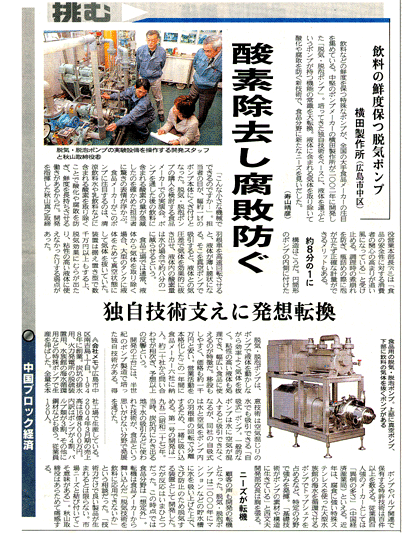
(Picture on upper left) Yokota's R&D staff operating the testing machines
for the degassing/defoaming pump, and corporate director Akiyama (right).
(Picture on lower right) Degassing/defoaming pump for food products. The
vacuum pump is on the top, drawing gas from the beverage on the bottom.
For details of this product, please refer to Defoaming, Degassing Pump DP, ASP type. |