|
|
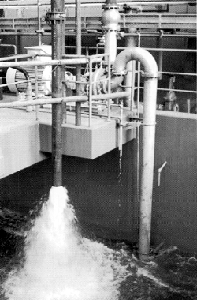
Air heater circulation flush pump
in operation at a thermal power plant
|
|
Pumping challenges ... Wear, corrosion, and self-priming
If asked, "What are the main concerns regarding pump operation?",
most answers would be, "wear", "corrosion", and, "pump
stoppage due to air mixed in with the pumped liquid". These are all
troublesome problems that are also costly.
"Wear" normally refers to wear of the shaft and other parts but
wear from slurry liquids especially affects the pump itself. "Slurry"
refers to a liquid that has granular particles mixed and if these particles
are hard, such as sand or limestone, they can readily cause pump wear.
As for troublesome "corrosion", it easily occurs when pumping
liquids that contain acids, alkalines, and salts.
To deal with "pump stoppage due to air mixed in with the pumped liquid",
it is common to use a "self-priming pump" with a foot valve or
similar device installed on the suction side to ensure the flow of priming
liquid. However, since the self-priming capability is not completely sufficient,
there is the constant concern that the pump may stop if air is suctioned
during pumping.
There are many cases where the use of a self-priming system has been abandoned
in favor of "forced pumping" using "submersible" (can
be submerged in water) or "vertical shaft" pumps. However, these
pumps present other serious concerns such as their vulnerability to corrosion
and the difficult and costly procedure of removing them from the water
for maintenance and inspection.
It seems impossible that one pump could simultaneously deal with all three
problems of "wear", "corrosion", and, "pump stoppage
due to air mixed in with the pumped liquid". It seems like we should
just give up....However, there is a land-based pump that can operate easily
under such difficult conditions and overcome all three of the problems
simultaneously. It's the YOKOTA Self-Priming Centrifugal Pump (PAT.).
What's different about the YOKOTA Self-Priming Centrifugal Pump?
While these problematic conditions are present simultaneously at locations
such as chemical factories, refineries, and wastewater treatment facilities,
we will use the example of a coal-fired thermal power plant to explain
how this pump is typically used.
|
|
|
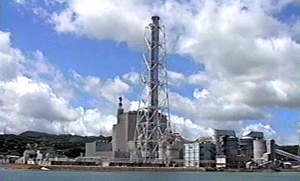
Coal-fired thermal power plant (Full view)
|
Overview of coal-fired thermal power plant
Since coal is the source for approximately 20% of all the energy used for
electric power generation in Japan, there are a large number of coal-fired
thermal power plants constructed and operating in the country.
At these plants, coal is pulverized and then burnt to generate highly pressurized
steam inside of boilers. This steam is used to turn turbines and generate
electricity.
The burnt coal produces smoke and, since Japan has the most stringent environmental
standards in the world, the coal-fired thermal power plants must perform
a thorough flue gas treatment for air pollution control.
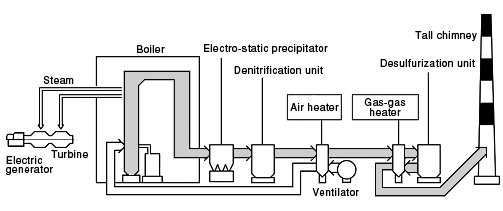
In a typical treatment process, the flue gas, which contains substances
such as coal ash (fly ash), nitrogen oxides (NOx), and sulfur oxides (SOx),
is sent to an electro-static precipitator that removes ash particulates
and then to a denitrification unit that removes nitrogen oxides.
The high-temperature flue gas is then channeled to the air heater where
heat exchange is performed with inducted fresh air so that it can be sent
to the boiler. Due to this heat exchange, the heat of the flue gas can
be effectively utilized.
After the heat of the flue gas has been transferred to the fresh air, it
is sent to the gas-gas heater where heat exchange is performed again with
the flue gas sent to the chimney and then it is channeled to the desulfurization
unit.
Then, after the sulfur oxides have been removed by the desulfurization
unit, the flue gas passes back through the same gas-gas heater to be exhausted
from the chimney.
|
Flue gas treatment process at a coal-fired thermal power plant
|
|
Circulation flush pump for the air heater and gas-gas heater
The internal filter of the air heater must be cleaned periodically due
to ash and rust left by the flue gas that accumulates in the heater, reducing
the heat exchange efficiency.
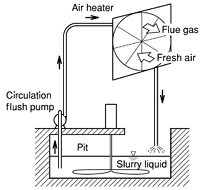
Cleaning is normally performed by using a "circulation flush pump"
that suctions water stored in a pit, pressurizes it, and then sprays it
out under high pressure. Since the material accumulated on the filter is
dispersed into the water, creating slurry, a huge rotor blade is installed
in the pit, constantly stirring the mixture until cleaning is completed.
The internal filter of the gas-gas heater is periodically washed off using
a similar process.
|
|
|
|
|
Air heater filter cleaning system
|
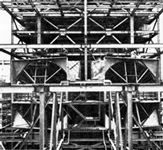
Air heater
|
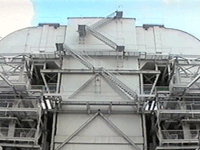
Gas-gas heater
|
Resolving circulation flush pump concerns
The circulation flush pump for the air heater and gas-gas heater must have
sufficient pumping capability to suction and pump slurry liquid. Furthermore,
the pump material must be highly corrosion resistant since the liquid used
to clean the gas-gas heater contains strong acids.
At a certain coal-fired thermal power plant, conventional vertical shaft
pumps were used until 1986. However, they presented the following concerns.
|

|
The pumping equipment was large and costly.
|
|
|
The main part of the pump was submerged, making maintenance troublesome
and costly.
|
|
|
Due to slurry, pump impeller, casing, and other parts suffered considerable
wear. Also, bearings would wear out, causing vibration. This entailed replacement
costs.
|
|
|
Pump corrosion was also severe. This entailed replacement costs.
|
In order to solve these problems at this plant, land-based horizontal pumps
were planned for the first time to be used as circulation flush pumps in
1986 when the plant underwent an expansion.
Foot valves cannot be used due to the slurry liquid. For this reason, using
land-based horizontal pumps requires them to have a strong self-priming
capability. The YOKOTA Self-Priming Centrifugal Pump (PAT.) was selected
because it is quite possibly the only pump capable of self-priming and
high-pressure pumping of slurry liquid.
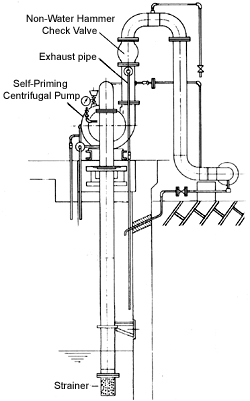
The YOKOTA Non-Water Hammer Check Valve was installed to prevent water
hammer when the pump is stopped and to ensure stable pumping. The Non-Water
Hammer Check Valves close at exactly the moment when change in flow from
the normal to the reverse direction occurs, that is, when the liquid in
the pipes stops flowing after the pump is stopped. As a result, water hammer
due to reversed flow does not occur, thereby preventing pipe ruptures and
pump damage.
YOKOTA's independently developed special stainless steel YST alloy, proven
to have high corrosion and wear resistance under a wide range of conditions,
is used for these pumps and valves.
The results of using YOKOTA pump system clearly showed that the problems
presented by the conventional vertical shaft pumps were completely resolved.
Additionally, facility and maintenance inspection costs were all greatly
reduced.
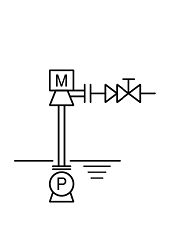
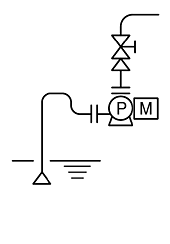
Comparisons of different pumps
|
Classification
|
Submerged pump
|
Vertical shaft pump
|
YOKOTA Self-Priming
Centrifugal Pump
|
|
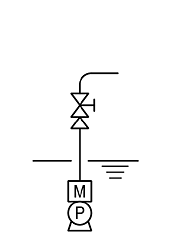
Structure
|
|
|
|
|
Corrosion
|
Corrosion occurs easily since the pump is submerged in water.
|
Corrosion occurs easily since the pump is submerged in water.
|
Corrosion does not readily occur.
|
|
Bearing maintenance
|
Bearing maintenance is difficult since the pump is submerged in water.
|
Bearing maintenance is difficult since the pump is submerged in water.
|
Maintenance can be performed easily due to stabilizing ball bearings.
|
|
Maintenance/Inspection
|
Pump and pump motor are submerged in water making maintenance inspection
difficult.
Pump and pump motor must be pulled up for disassembly.
|
Pump is submerged in water making maintenance inspection difficult.
Motor must be transferred for disassembly.
|
Maintenance inspection can be performed easily since it is situated on
land.
It is not necessary to transfer the motor for disassembly.
|
|
Facility costs
|
Pump and pump motor costs are high.
|
Pump and pump motor costs are high.
|
Pump and pump motor costs are low.
|
|
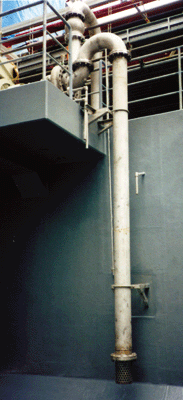
Air heater and gas-gas heater circulation flush pump system
|
|
 |
|
|
Pump: UHN type 200mm x 5.5m3/min x 75m x 1750min-1 x 120kW
|
Due to the recognition of the positive accomplishments achieved with air
heaters, gas-gas heaters, and other units, YOKOTA pumps and valves (including
those used at other locations within the plant) have been supplied to a
large number of electrical power plants.
Regarding the YOKOTA Self-Priming Centrifugal Pump UHN type (PAT.)
|
|
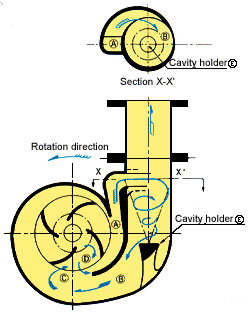
Casing consists of a simple construction with a semi-double volute and
a cavity holder. A single-suction, single-stage pump displaying outstanding
pumping efficiency in a wide assortment of specifications.
|
|
|
Outstanding self-priming power, with a maximum vacuum reaching 60-90kPa
(6-9m water column).
|
|
|
Low NPSH. Even if cavitation develops due to fluctuation in intake conditions,
this pump can still continue pumping operation and does not require allowance
for NPSH.
|
|
|
Even if pumping becomes subject to air suction or mixture of air during
pumping operation, it continues pumping without a problem. Even continuous
suction of air-containing water (i.e., gas-liquid two-phase pumping) is
possible.
|
Self-priming mechanism (PAT.)
|
1. Circulation flow
|
|

|
During self-priming, the water discharged from passage A in the semi-double
volute returns to the impeller through passage B-C, and is discharged again
into passage A.
|
|
2. Bubble removal
|
|
|
This recirculation flow mixes the water and the air in the center with
intense vortex D within the impeller and discharges it into passage A.
|
|
3. Water-air separation and exhaust
|
|
|
The water-air mixture is led from passage A to discharge nozzle B in a
cyclonic state and automatically separated by centrifugal force, and then
the water is recirculated through passage B-C. The separated air is held
by cavity holder E, and then compressed and discharged against the back
pressure.
|
|
| Self-Priming Centrifugal Pump UHN series |
|
|
|
Regarding the YOKOTA Non-Water Hammer Check Valve (PAT.)
|
|
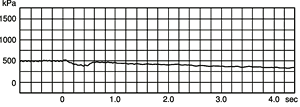
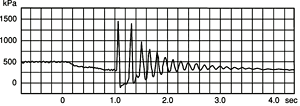
The valve opens and closes in response to water flow, therefore there is
no delay in valve closure and water hammer does not occur.
|
|
|
The single-disk, simple construction eliminates breakdowns. Maintenance
costs can be reduced considerably.
|
|
|
The No-Feed Detector can also be installed optionally.
|
Pressure change with time after pump operation is stopped
|
|
| YOKOTA Non-Water Hammer Check Valve |
Conventional check valve |
|
 |
 |
|
Regarding YST alloy (YOKOTA stainless steel alloy YST series)
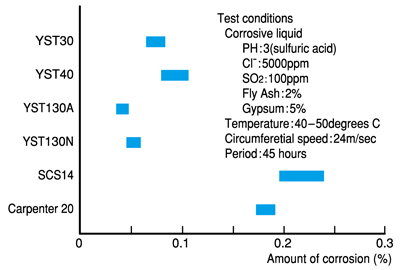
YOKOTA's independently developed special stainless steel alloy, YST series,
with enhanced corrosion resistance as well as wear resistance, has been
favorably received as a standard material suitable for pumps and valves
in equipment for anti-pollution treatment, seawater treatment, and chemical
processing among others.
Moreover YOKOTA's duplex stainless steel YST 130N is an excellent seawater
and chemical resistance material.
Starting from the casting process, the YST series is wholly manufactured
in-house by YOKOTA to ensure complete quality control of materials and
the casting process.
Advantages of YST alloy
|
|
Excellent corrosion resistance, especially against localized corrosion
due to the presence of chloric ions.
|
|
|
Improved wear resistance due to improved hardness, resulting in both corrosion
and wear resistance.
|
|
|
Excellent resistance to pitting and crevice corrosion in seawater.
|
|
|
Outstanding strength (nearly twice as strong as general JIS materials).
|
|
|
Easily welded by covered arc or TIG welding without preheating or residual
heating.
|
|
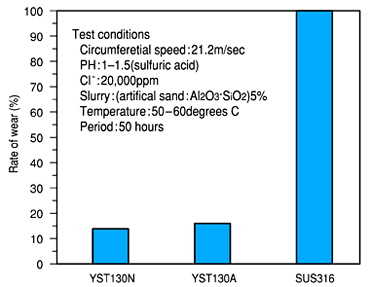
YST series corrosion/wear resistance
|
|
 |
|
YST series corrosion/wear resistance (Compared to when SUS316 has 100%
wear due to 5% slurry)
|
|
 |
|
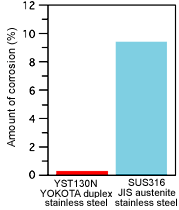
YST130N crevice corrosion resistance
|
|
|
Loss due to crevice corrosion
|
|
|
Field test with actual liquid
(seawater + hypochlorous acid (90-100ppm))
Test period: approx. 1 year and 9 months
|
|
|
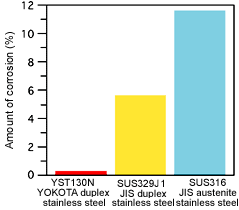
YST130N pitting corrosion resistance
|
|
Loss due to pitting corrosion
|
|
5% ferric chloride 40 deg C, 50 hours
|
|
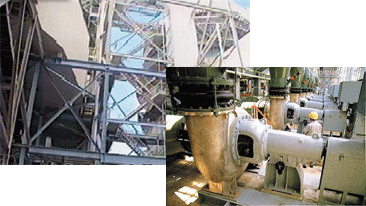
The final step in flue gas treatment at coal-fired thermal power plants
is the flue gas desulfurization unit. YOKOTA YST alloy is also being used
in these units.
The desulfurization unit uses limewater to eliminate sulfur oxides (SOx)
from flue gas. The YOKOTA Mixed-Flow Volute Pump YM type, constructed with
YST alloy, is used in large numbers in order to circulate (non-self-priming
type pumps are used in this situation) the limestone slurry created in
this process. YOKOTA's YST alloy has repeatedly proven its excellent durability
and reliability under the severely corrosive and abrasive conditions of
a flue gas desulfurization unit.
|
|
YST alloy used for YM type pump in flue gas desulfurization unit
|
For details of each product, please refer to
Self-Priming Centrifugal Pump UHN series
Mixed-Flow Volute Pump YM type
Non-Water Hammer Check Valve SL series
Special Stainless Steel YST series |
|