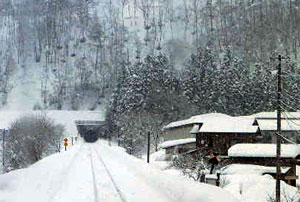
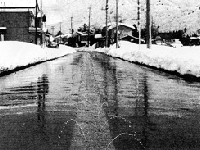
"The train came out of the long tunnel into the snow country..."
So begins the famous novel, Snow Country, by Yasunari Kawabata. While the
image of a "snow country" where so much snow falls that not a
spot of ground is visible is certainly romantic, to those who live there
nothing is as troublesome as the snow.
By the way, did you know that if we consider the complete surface area
of Japan, half the country can be considered "snow country"?
While there are various protective measures against snow and ice that are
taken to protect the lives and livelihoods of those living in "snow
country", the greatest number of problems related to snow come from
snowfall on railroad tracks and roadways.
One protective measure against snow and ice for railroads and roadways
is the "slush removal system" that hydraulically transfers collected
snow that has been removed from the railroad tracks or roadways and deposits
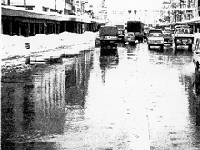
it in a river. Also, there is the "sprinkler snow melting system"
that melts snow by sprinkling water on the road surface.
A large number of pumps are used for these systems. While a normal pump
might be sufficient in many cases, under severe conditions that require
powerful suction force, such as hydraulically transferring slush with air
mixed into it, an ordinary pump would not be able to perform the task.
However, YOKOTA's Self-Priming Centrifugal and Enhanced Self-Priming Pumps
can be used for pumping at locations with such severe conditions. Thanks
to our unique continuous air-bleeding method (PAT.), difficult pumping
situations can be handled with ease.
We will use some actual examples of railroad tracks and roadways to show
how the YOKOTA Self-Priming Centrifugal and Enhanced Self-Priming Pumps
are utilized.
|
Example application 1 - "Railway station snow removal system" |
|
|
|
Railway station F in the Hokuriku region of Japan is located in a ravine,
8.5m below the bottom of a nearby river. Due to this, natural water drainage
cannot occur. This is the main reason why the snow-flowing gutters (side-gutters
where removed snow flows away) constructed early-on at a large number of
stations could not be used here.
In the autumn of 1983, a new "slush-mixture pumping system" for
snow removal was installed for the first time throughout Japan.
The system enables snow to be cleared from the tracks by just six people,
thereby eliminating the tremendous delays and cancellations of trains due
to heavy snowfall. To give an idea of what an advancement this represented,
before the implementation of the new system, it would take 50 people using
shovels one whole day to clear only the tracks around the switches.
What is the slush-mixture pumping system?
The "slush-mixture pumping system" was developed at the Snow
Damage Testing and Research Center of the Niigata Prefecture Science and
Technology Agency, and is a system that dumps snow into water, mixes the
two into a sherbet-like consistency and then pumps it away through a system
of pipes to deposit it at a distant location. It is also known as "hydropower
snow transport".
|
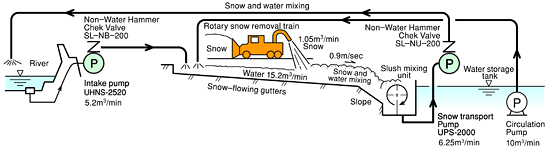
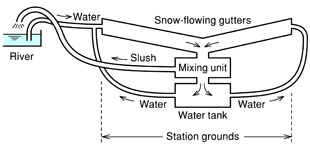
Slush-mixture pumping system outline
|
|
|
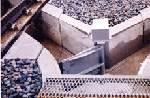
At this station, three separate snow-flowing gutters with a total length
of 1.2km were newly installed along the tracks within the station.
Since only 5.2 tons of water per minute can be pumped from the river (due
to river management conditions), a water storage tank was incorporated
into the snow-flowing gutters and water previously suctioned from the river
is held in this tank. By combining the 10 tons of water supplied from the
water tank with 5.2 tons from the river, 15.2 tons per minute can be supplied
to any one of the three snow-flowing gutters.
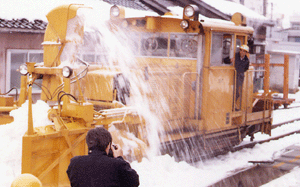
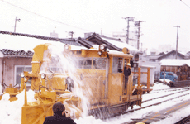
Snow on the tracks is suctioned up by a rotary snow removal train and deposited
in the snow-flowing gutters. This snow is guided to the rotating screw
in the slush mixing unit where it is finely ground.
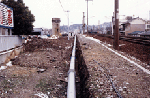
It is then passed through a grated filter and the sherbet-like slush is
pumped away through steel piping along the tracks to a discharge outlet
located on a river approximately 900m away. 5.2 tons of water and 1.05
tons of snow come gushing out of the discharge outlet every minute. The
remaining water that passes through the filter is circulated back into
the water storage tank.
Why use YOKOTA pumps?
The two main pumping jobs for this snow removal system require an "intake
pump" to suction water from the river and deliver it to the system,
and a "slush transport pump" to pump the slush mixture (made
from the river water and the removed snow) to the discharge point on the
river.
A regular pump cannot possibly offer the capabilities, as listed below,
required of these pumps.
|

|
The "intake pump" must be capable of effectively suctioning and
pumping water from the river through an extended suction piping system
and, moreover, through piping that goes over embankments (elevated locations).
|
|
|
Since the "slush transport pump" handles the slush ground by
the mixing unit that contains 30% to 40% air, the pumping capacity of a
regular pump attempting to suction this slush would be drastically reduced,
resulting in pump stoppage. A pump that is capable of continuous slush
suction operation while discharging contained air is required.
|
Therefore, YOKOTA Self-Priming Centrifugal and Enhanced Self-Priming Pumps
have been selected since they possess the capabilities required to satisfy
these strenuous requirements.
Furthermore, YOKOTA's Non-Water Hammer Check Valve has been adopted for
these pumps to prevent water hammer when the pump is stopped and ensure
stable pumping.
|
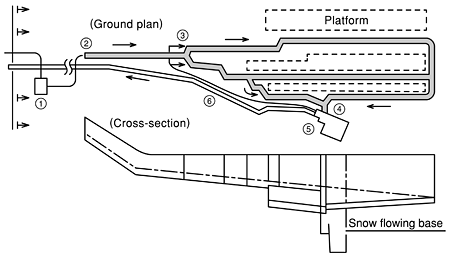
Station grounds diagram
|
|
|
|
|
|
1:
|
Intake pump
|
|
2, 3, 4:
|
Snow-flowing gutters
|
|
5:
|
Slush mixing unit, Slush transport pump
|
|
6:
|
Slush transport piping
|
|
 |
 |
 |
|
 |
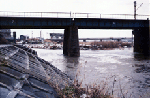
| River water intake |
|
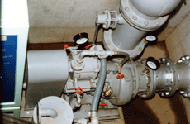
Intake pump: UHNS type with
Non-Water Hammer Check Valve |
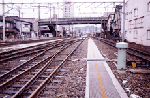
Snow-flowing gutter |
|
|
|
|
 |
 |
 |
 |
|
 |
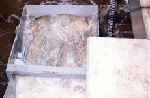
| Slush mixing unit |
|
Snow-flowing gutter |
|
Rotary snow removal train
depositing snow from the tracks
into the snow-flowing gutter |
|
|
|
|
|
 |
|
 |
|
 |
Slush transport pump: UPS type with
Non-Water Hammer Check Valve |
Slush transport piping |
|
Discharge outlet provided at river |
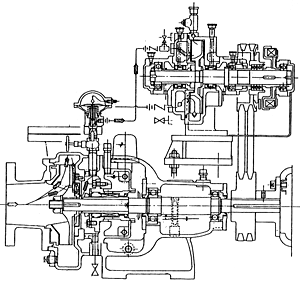
YOKOTA Self-Priming Centrifugal Pump UHNS type (PAT.) used for water intake
... Self-priming even with extended lengths of suction piping
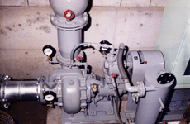
The YOKOTA Self-Priming Centrifugal Pump UHNS type was chosen for the intake
pump because it can handle the rigorous suction requirements of extended
lengths of suction piping that goes up and over embankments.
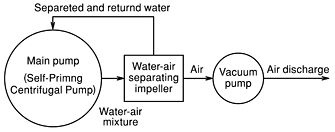
The Self-Priming Centrifugal Pump with a strong self-priming capability
is used as the main pump and is supplemented by a vacuum pump to further
increase self-priming capability and reduce self-priming time. Also, a
water-air separating impeller is installed between the main and vacuum
pumps to provide our patented "continuous air-bleeding mechanism"
that prevents water or mud from entering the vacuum pump.
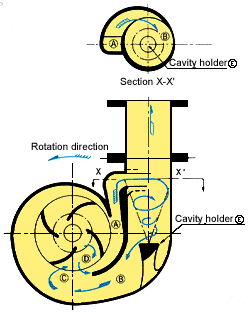
Since the main pump possesses its own self-priming capability, the vacuum
pump can be stopped under normal conditions.
|
Continuous air-bleeding mechanism (PAT.)
|
Self-priming mechanism (PAT.)
|
|
|
|
|
UHNS type structural view |
|
|
|
YOKOTA Enhanced Self-Priming Pump UPS type (PAT.) used for slush transport
... Discharges air while pumping
The YOKOTA Enhanced Self-Priming Pump UPS type with a non-clogging impeller
was selected for the slush transport pump that is the central heart of
this snow removal system.
The sherbet-like slush ground by the mixing unit contains 30% to 40% air,
and is in a state of "multiphase flow", i.e., air-solid-liquid
mixture.
A regular pump attempting to suction this slush would suffer a loss of
pumping capacity or pump stoppage. However, the YOKOTA Enhanced Self-Priming
Pump has a vacuum pump that operates constantly, removing air from the
mixture to ensure constant and stable pumping. Also, slush cannot enter
the vacuum pump due to the operation of the water-air separating impeller.
|
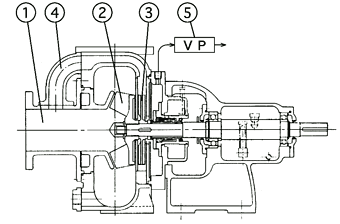
|
|
|
1:
|
Suction inlet
|
|
2:
|
Main impeller
|
|
3:
|
Water-air separating impeller
|
|
4:
|
Return passage
|
|
5:
|
Vacuum pump
|
|
YOKOTA Enhanced Self-Priming Pump mechanism (PAT.)
|
1.
|
The water-air separating impeller (3) is installed between the centrifugal
pump and the vacuum pump.
|
|
2.
|
When operation is started, the main impeller (2) of the centrifugal pump
runs idle and the vacuum pump (5) operates, eliminating the air in the
suction pipe.
|
|
3.
|
When the air is completely eliminated, the pumping liquid flows into the
pump casing, and is discharged by the main impeller (2).
|
|
4.
|
The mixture of water and air in the center is drawn by the vacuum pump
(5), goes to the water-air separating impeller (3) from behind the main
impeller.
|
|
5.
|
The water-air separating impeller (3) separates the water from the air
instantly by centrifugal force.
|
|
6.
|
The water returns to the suction inlet (1) through the return passage (4),
and only the air collected in the center of the water-air separating impeller
(3) is drawn out by the vacuum pump (5).
|
Accordingly, incoming air does not block the pump suction inlet or main
impeller since the suction side is always operated under the vacuum pump's
maximum vacuum and bleed amount conditions. This results in stable, high-level
pump performance.
Moreover, because the movement of the water-air separating impeller prevents
penetration of mud, sand, and earth in the vacuum pump, pumping efficiency
is ensured and safe.
|
Example application 2 - "Roadway sprinkler snow melting system" |
|
|
|
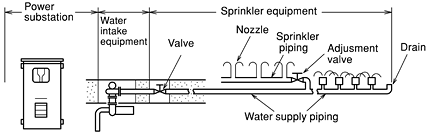
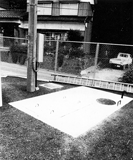
The "sprinkler snow melting system" is simply a method to melt
snow by sprinkling water on the roadway. As shown in the figure above,
it consists of a pump that intakes water and supplies it to the sprinklers
where the water is sprinkled onto the road surface via the nozzles.
While various types of water, such as ground, river, sea, or hot springs
water, can be used, conventional systems mainly used groundwater. But,
since suctioning out too much groundwater can result in a lower water level
or ground sinkage, the use of river water has recently been gaining prominence
as a way to avoid these problems.
The main economic activities of Town K in Shiga Prefecture are agriculture
and forestry-related. It snows 33 days out of the year and yearly snowfall
is 290mm.
A sprinkler snow melting system was first introduced in this town in 1977.
From that time until 1991, the system grew to consist of intake pumps in
15 locations and a snow melting pipe network with a total length of 9km.
Of these 15 locations, the YOKOTA Totally Waterproof Self-Priming Centrifugal
Pump System is installed in 3 locations for river water intake.
The main economic activity of Town K in Tottori Prefecture consists of
pear trees, grape orchards, and other fruit farming. It snows 50 days out
of the year and yearly snowfall is 900mm.
A sprinkler snow melting system was first introduced in this town in 1981.
From that time until 1991, the system grew to consist of 11 sprinkling
locations and a snow melting pipe network with a total length of 7.4km.
The YOKOTA Totally Waterproof Self-Priming Centrifugal Pump System is also
installed here in one of the locations for river water intake.
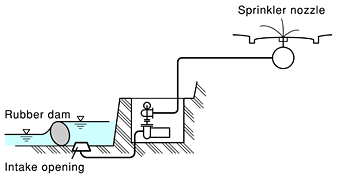
While these pumps intake river water, there are nearby river water irrigation
channels for agricultural use that are not used during the winter from
which water is drawn. However, since the water level is reduced in the
winter, a cylindrical-shaped rubber balloon ("rubber dam") is
used to block and store water, as shown in the figure, which can then be
pumped out. Then, in spring, when the water is needed for agricultural
purposes, the dam is deflated so that the water can be utilized accordingly.
Why use YOKOTA pumps?
While submersible or horizontal centrifugal pumps are normally used for
groundwater or river water intake, they have the following disadvantages:
Submersible pumps...
|
|
The life of a submersible pump is reduced since it is constantly submerged
in water and, at worst, may start to malfunction within one year and have
to be replaced.
|
|
|
Even if the pump only requires maintenance, a great deal of work is needed
to pull it out of the water, increasing the overall cost.
|
Horizontal centrifugal pumps...
|
|
While the life of a horizontal centrifugal pump is much longer than that
of a submersible one, and maintenance of the pump is easier because it
is land-based, it requires a site for the pump room.
|
|
|
Countermeasures must be taken against noise and to prevent freezing in
the winter.
|
|
|
If air is suctioned into the pump, pumping capacity may be lost completely
and, therefore, reliable automatic pump operation cannot be guaranteed.
|
However, all of these problems can be easily resolved by using the YOKOTA
Totally Waterproof Self-Priming Centrifugal Pump System.
YOKOTA Totally Waterproof Self-Priming Centrifugal Pump System (PAT.) used for water intake
... Self-priming system operates easily, even underwater
Advantages of the YOKOTA Totally Waterproof Self-Priming Centrifugal Pump
System
|
|
There is no need to worry about a pump site because the pump is located
in an underground pit under a sidewalk or similar location.
|
|
|
The pump has an advantage in that there is no need for countermeasures
against winter freezing because the temperature in the underground pit
is warmer than that at ground level. Another advantage is that noise is
also not a problem due to the underground pump location.
|
|
|
Although water may fill the underground pit, submerging the pump, there
is no reason for concern because the pump with its attached submersible
motor is completely waterproof.
|
|
|
The greatest advantage of this pump is that it can continue pump operation
easily even if air is suctioned into the system.
The Self-Priming Centrifugal Pump UHPR type with a submersible motor, with
it's strong self-priming capability, is used as the main pump, and is supplemented
by the YOKOTA Vacuum Pump to further increase self-priming capability.
Due to YOKOTA's unique continuous air-bleeding method (PAT.) the vacuum
pump operates to bleed out air even if a large amount of air is suctioned
into the system, so there is absolutely no need to worry about pump seizure
due to racing of the motor.
|
|
|
The YOKOTA Non-Water Hammer Check Valve (PAT.) is included to further increase
operational reliability. Since the snow melting pipe is anywhere from a
few hundred meters to over one kilometer in length, even one incident of
water hammer is certain to spread system-wide and cause serious damage.
However, the use of the Non-Water Hammer Check Valve provides reliable
protection against the occurrence of water hammer.
|
In other words, the YOKOTA Totally Waterproof Self-Priming Centrifugal
Pump System can be situated underground for hands-free operation due to
it being submersible (completely waterproof) and capable of handling air
mixed into pumped liquid (complete air-bleeding type). This pump system
has been adopted based on its reputation for convenience.
|
|
|
|
|
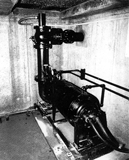
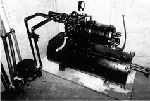
Ground area above
underground pit
|
Self-Priming Centrifugal Pump
with submersible motor in
underground pit
|
Vacuum pump
in underground pit
|
|
|
|
|
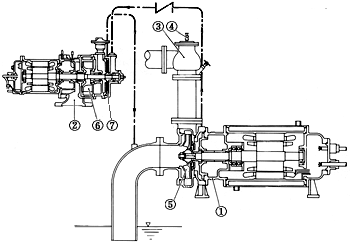
1:
|
Self-Priming Centrifugal Pump UHPR type (Main pump)
|
|
2:
|
Vacuum pump
|
|
3:
|
Non-Water Hammer Check Valve
|
|
4:
|
No-Feed Detector
|
|
5:
|
Main impeller
|
|
6:
|
Vacuum pump impeller
|
|
7:
|
Water-air separating impeller
|
|
|
With the addition of the Non-Water Hammer Check Valve and No-Feed Detector
to the interlocked Self-Priming Centrifugal Pump UHPR type (main pump)
and vacuum pump with submersible motors, the system offers completely automatic
operation.
|
(1)
|
When the switch is turned on, the main and vacuum pumps are activated at
the same time.
|
|
(2)
|
Air in the suction piping enters the main pump and then is rapidly discharged
by the vacuum pump. When water fills the inside of the main pump, pumping
begins.
|
|
(3)
|
When pumping begins, the vacuum pump automatically stops to conserve energy.
|
|
(4)
|
Pumping continues even if air is suctioned into the system due to the self-priming
capability of the main pump.
|
|
(5)
|
If, by chance, a large amount of air is suctioned causing pumping capability
to be lost, this will be detected by the No-Feed Detector, the vacuum pump
will be activated, and air will be rapidly discharged due to simultaneous
operation.
|
When the main and vacuum pumps are operated simultaneously, pumped water
tends to flow toward the vacuum pump. With regular vacuum pumps, mud mixed
in with the pumping liquid may cause a malfunction, but the air-bleeding
system (PAT.) of the YOKOTA Vacuum Pump includes a water-air separating
impeller (7), installed in front of the vacuum pump impeller (6), that
separates water, mud, and other substances, returning them to the suction
side so that only air is discharged to the outside.
The vacuum pump, protected by this structure, is able to rapidly discharge
even large amounts of air so that the main pump is not stopped and continuous
pumping operation is possible.
This allows completely hands-off operation capability and is a major advantage
of the YOKOTA Vacuum Pump.
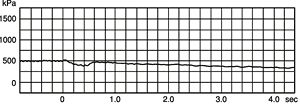
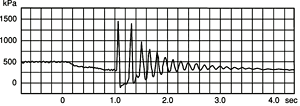
Regarding the YOKOTA Non-Water Hammer Check Valve (PAT.)
All of the above-mentioned pumps are equipped with YOKOTA Non-Water Hammer
Check Valves for safe pumping.
|
|
The Non-Water Hammer Check Valves close at exactly the moment when change
in flow from the normal to the reverse direction occurs, that is, when
the liquid in the pipes stops flowing after the pump is stopped. As a result,
water hammer due to reversed flow does not occur, thereby preventing pipe
ruptures and pump damage.
|
|
|
The single-disk, simple construction eliminates breakdowns. Maintenance
costs can be reduced considerably.
|
|
|
The No-Feed Detector can also be installed optionally.
|
Pressure change with time after pump operation is stopped
|
|
| YOKOTA Non-Water Hammer Check Valve |
Conventional check valve |
|
 |
 |
|
For details of each product, please refer to
Self-Priming Centrifugal Pump UHN series (UHNS, UHPR types)
Enhanced Self-Priming Pump UPM, UPS types
Non-Water Hammer Check Valve SL series
|
|