|
Resolving the concerns of sewage treatment and water-purifying plants
YOKOTA Enhanced Self-Priming Pump UPM, UPS types (PAT.)
The important life line that supports our modern lives is our water supply
and sewer systems.
Normally, we pay little attention to our use of the water supply and sewer
system until there is a disruption caused by some natural disaster, then
we realize its importance and the arduous efforts required to maintain
the system.
Recently, the role of the water supply and sewer system is becoming more
important than ever before for conservation of the natural environment.
Promoting efficiency and reducing cost are also important tasks.
YOKOTA, as a company finding solutions to water and liquid handling needs,
offers you various means of solving your concerns with pump and valve equipment
for water supply and sewer systems to help you promote efficiency and reduce
costs.
The following are some examples.
|
"Concern 1" - Sewage treatment plants |
|
|
|
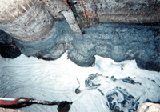
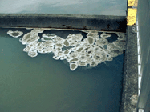
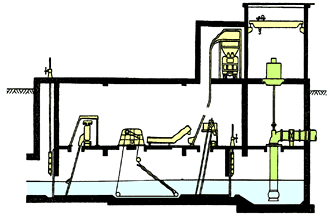
When an excess amount of rainwater enters the holding tank of a sewage
treatment plant, it is discharged using a rainwater pump, although some
rainwater that could not be discharged remains in the tank.
Rainwater retained in the tank starts to decay and smell over time.
If this polluted and odorous rainwater were to be released into the river,
the river would also become polluted and smelly, resulting in environmental
problems.
Is there any appropriate method to handle this problem?
|
|
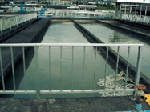
Holding tank description
|
|
|
"Concern 2" - Sewage treatment plants |
|
|
|
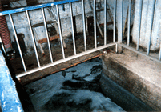
Sewage collecting at sewage treatment plants contains large amounts of
soil as well as pebbles and sand.
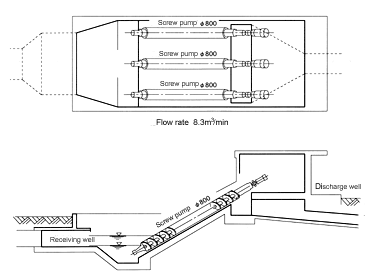
Sewage flowing into a receiving well is sent to a discharge well by a large
"screw pump" after soil in the sewage is removed by a soil extractor.
It is extremely expensive to transfer sewage from a receiving well to a
discharge well (construction, equipment, and maintenance costs).
Is there any way to effectively reduce these costs?
|
|
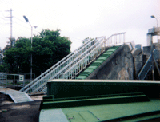
Screw pump external view
|
|
"Concern 3" - Water purification plants |
|
|
|
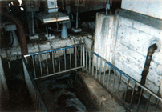
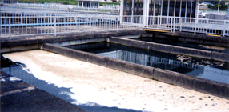
There are between 10 and 20 sedimentation ponds located at water purification
plants.
There is a lot of floating matter such as algae and floating grass on the
surface of sedimentation ponds.
Floating matter on sedimentation ponds is removed by hand. Removing all
of it using a net is labor intensive and expensive.
Is there an easier method?
The YOKOTA Enhanced Self-Priming Pump UPM, UPS types have addressed these
problems.
|
For "Concern 1", YOKOTA can solve environmental problems
at low cost. |
|
|
|
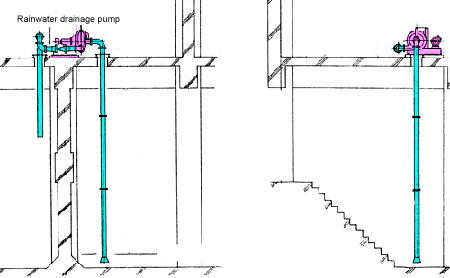
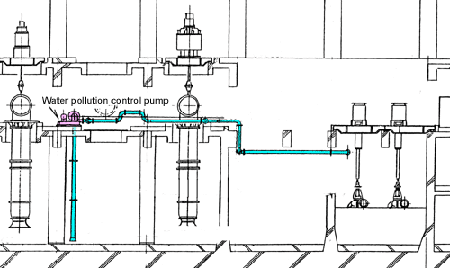
The YOKOTA Enhanced Self-Priming Pump UPS type can draw up retention water
from a holding tank, and then pressurize it to deliver it to a sewage treatment
plant.
As a result, polluted and odorous retention water is not released into
rivers. This pump has been highly evaluated for its role in environmental
conservation of rivers, and odor reduction from holding tanks.
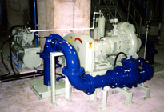
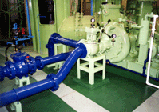
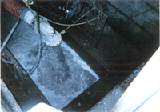
A City Sewerage Bureau D Pumping Station
|
|
|
Administrative building,
rainwater drainage pump |
Rainwater drainage building,
rainwater drainage pump |
Pumped retention water |
|
A City Sewerage Bureau D Pumping Station
|
|
Rainwater drainage pump: UPS-20-1520N
|
|
|
|
A City Sewerage Bureau T Treatment Plant
|
|
Water pollution control pump: UPS-20-1520N
|
|
|
|
For "Concern 2", YOKOTA can reduce drainage transference
cost by 50%. |
|
|
|
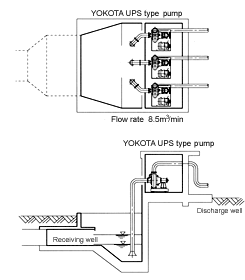
The YOKOTA Enhanced Self-Priming Pump UPS type can easily transfer the
drainage from a receiving well to a discharge well instead of a "screw
pump". Moreover, 50% of the cost for construction, equipment, and
maintenance can be reduced.
|
Construction cost:
|
Equipment space (both inside and outside) can be reduced by approximately
50%, reducing construction cost significantly.
|
|
Equipment cost:
|
Equipment cost can be reduced by more than 50% by using the UPS type pumps.
|
|
Maintenance cost:
|
A non-clogging impeller has been adopted on the UPS type pump structure,
and YOKOTA duplex stainless steel alloy YST130N has been used on the drainage
passage for high corrosion and wear resistance. In addition, maintenance
is easier compared to submersible pumps since it is horizontally mounted
on the floor.
|
|
|
|
|
Comparison with conventional type and the YOKOTA UPS type
(image comparison including the equipment space)
|
Conventional type
|
YOKOTA UPS type
|
|
|
|
For "Concern 3", YOKOTA can improve work efficiency substantially
while reducing labor intensity. |
|
|
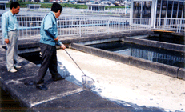
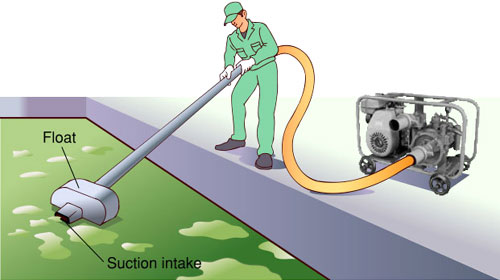
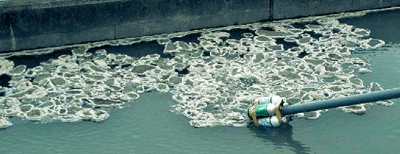
The YOKOTA Enhanced Self-Priming Pump UPM type removes floating matter
easily, improving working efficiency substantially, and reducing cost.
The actual work process is like using a vacuum cleaner at home.
The light YOKOTA Enhanced Self-Priming Pump UPM10 type can suction floating
matter quickly and pump it to a specified place.
If you choose the higher vacuum performance pump (option) according to
the usage, work efficiency will further improve.
|
Suction intake (test product)
|
 |
|
|
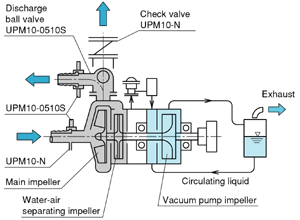
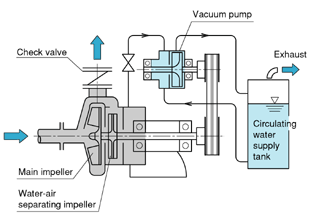
About the YOKOTA Enhanced Self-Priming Pump UPM, UPS types (PAT.)
This is a volute pump with an interlocked water-air separating impeller
and a vacuum pump.
The mixture of water and air gathered in the center of the volute pump
is centrifugally separated by rotation of the water-air separating impeller
and only the air is drawn out by the vacuum pump. Therefore, the volute
pump always shows stable and supreme pumping performance without being
blocked by the air.
Unique features
|

|
Capable of continuous suction and transfer of liquids containing air or
solids such as high viscosity liquid, muddy water containing gravel, and
sewage containing empty cans (i.e., gas-solid-liquid multiphase flow).
|
|
|
Enhanced self-priming type which needs no priming liquid even at initial
operation after installation.
|
|
|
The intake piping can be constructed in many ways such as with waved pipes
or across embankments.
|
|
|
A wide variety of materials are available, including YOKOTA's corrosion
and wear resistant special stainless steel casting (YST) among others.
|
|
UPM type: Vacuum pump built-in type
|
UPS type: Vacuum pump mounted/separate types
|
|
|
For details of each product, please refer to
Enhanced Self-Priming Pump UPM, UPS types
Special Stainless Steel YST series
|