|
Resolving the concerns of seawater pumping
YOKOTA Seawater Intake Pump (PAT.)
|
|
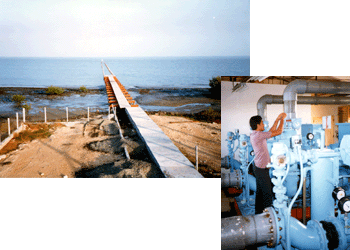
The Yokota Seawater Intake Pump provides suction of seawater from the sea.
|
|
The ultimate method of solving water shortages in various countries is
the use of the inexhaustible supply of seawater.
In this respect, there is a growing trend for the use of seawater. Salt
production is one obvious use, however, recently factories and power generating
facilities are using vast amounts of seawater for cooling and, with the
use of desalination equipment, major production of drinking water is being
carried out. Moreover, fish farms are increasingly finding it easier to
raise fish in land-based hatchery ponds by pumping in seawater rather than
managing a fish farm on the sea itself.
What are the problems with seawater intake?
In the past, seawater intake was generally done using immersion type pumps
such as a submerged pump or vertical pump.
The main reason for this was because of the poor seawater pumping efficiency
of land-based pumps.
Difficult pumping conditions are common due to factors such as poor self-priming
efficiency from the extrication of air and bubbles which occurs easily
in seawater, too much distance from the water suction intake, and pipes
crossing over embankments. With no strong self-priming pumps that could
meet these demands, the solution closest at hand was "forced pumping
operation" with submergible pumps.
However, for submerged pumps, because the pump motor is submerged together
with the pump, there are concerns with the power supply, corrosion, and
the danger of damage caused by rough seas. Added to this is the troublesome
work of pulling up a submerged pump to perform maintenance inspection.
As for vertical pumps, because the main part of a vertical pump is submerged
in water, they are prone to the danger of flood-tides and typhoons. What's
more, the large size of the equipment means higher construction costs,
and the added trouble of performing inspection on the main part of the
pump.
Although there are land-based volute pumps equipped with a vacuum pump
for priming liquid, it is usually the case that the vacuum pump is cut-off
at the same time priming is finished to prevent damage to the vacuum pump
from penetration of seawater. For this reason, if air suction occurs during
pump operation, pumping becomes difficult.
Also, because suction power is not strong enough, pumping through suction
pipes across embankments is not possible.
This situation is further problematic in areas where boring through embankments
or barriers is not permitted by port and harbor regulations. Consequently,
it becomes necessary to set a pump on a landfill at the same height as
the embankment. This only increases the concern over loss of pumping ability
due to the increase in suction height.
The newly conceived YOKOTA Seawater Intake Pumps are the clear answer to
these concerns.
What is different about YOKOTA Seawater Intake Pumps?
Seawater intake pump comparative chart
|
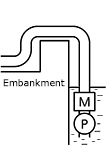
Submerged pump
|
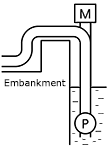
Vertical pump
|
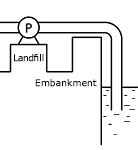
Conventional centrifugal pumps equipped with a vacuum pump
|
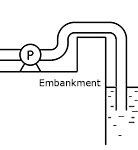
YOKOTA Seawater Intake Pumps (Patented continuous air-bleeding type)
|
|
|
|
|
|
Danger of damage from flood-tides and typhoons.
Maintenance inspection extremely difficult.
High concern for power supply.
|
Danger of damage from flood tides and typhoons.
Maintenance inspection is difficult.
High construction cost due to large facility requirement.
|
Pumping problems due to air suction.
Uncertainty of pumping efficiency with increase of pump head.
High construction cost due to pump set-up on landfill.
|
Air suction during pumping is no problem.
No loss of pumping efficiency.
Low construction cost because piping across embankments is possible.
|
YOKOTA Seawater Intake Pumps, with their patented construction of a "continuous
air-bleeding" method which interlocks a bleed pump (vacuum pump) to
the centrifugal pump, provide strong priming efficiency without penetration
of seawater or muddy water into the vacuum pump even during continuous
suction.
|

|
Superior suction performance
|

|
Superior suction performance from the continuous operation of the vacuum
pump.
|
|
|
Air intake is no problem
|
|
Using continuous air-bleeding, pumping continues without any problems,
even if air is sucked into the system or air dissolved in seawater becomes
extricated during pumping.
|
|
|
Piping across embankments
is possible
|
|
Due to the superior pumping efficiency, piping shaped around embankments
and various types of man-made and natural sea barriers is possible.
|
|
|
Complete automatic operation
possible
|
|
Because the pumps require neither a single drop of priming liquid nor a
cut-off operation for the vacuum pump, complete automatic operation is
realized.
|
|
|
Simple maintenance
inspections
|
|
Maintenance inspection is easy and safe for pumps set in land-based pumping
houses.
|
|
|
Cost reduction
|
|
Construction costs are cheaper because pipe construction over embankments
is possible, and large facilities or landfill preparation is unnecessary.
|
The YOKOTA Seawater Intake Pump has received high marks based on the above
merits and is being used widely both domestically and abroad.
What is the continuous air-bleeding YOKOTA Vacuum Pump?
The greatest advantage of the continuous air-bleeding method lies in the
YOKOTA's unique vacuum pump.
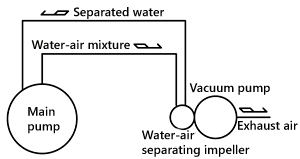
The patented construction of the vacuum pump with its built-in water-air
separating impeller does not allow penetration of seawater or muddy water
into the vacuum pump even during continuous air-bleeding.
|
1.
|
When operation begins, both the main pump and vacuum pump operate simultaneously,
removing air in the suction pipes.
|
|
 |
|
2.
|
When the air is completely removed, pumping water reaches the main pump
casing and is discharged by the main impeller.
|
|
3.
|
The water-air mixture in the center of the main impeller is drawn by the
vacuum pump to the water-air separating impeller.
|
|
4.
|
The water-air mixture is separated instantly by centrifugal force by the
rotation of the water-air separating impeller.
|
|
5.
|
The water follows a return passage to the main pump intake, and only air
collected in the central area of the water-air separating impeller is drawn
into the vacuum pump.
|
Accordingly, the suction intake side of the main pump is always operating
under conditions of maximum vacuum and bleed amount from the vacuum pump,
and as a result, pumping is not interrupted because there is no air obstruction
in the main pump.
|
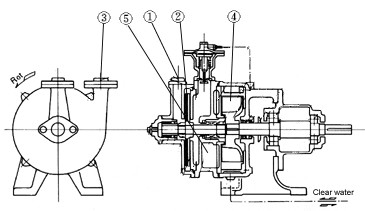
YOKOTA Vacuum Pump VP-K type (PAT.)
|
|
|
|
|
1: Suction intake
|
|
2: Water-air separating impeller
|
|
3: Separated water outlet
|
|
4: Vacuum pump impeller
|
|
5: Exhaust air outlet
|
|
The following main pumps are available in consideration of self-priming
ability and pumping capacity.
|
|
Self-Priming Centrifugal Pump UHN type (small-medium capacity, self-priming
type):
|
|
Suction power is enhanced with the interlocked vacuum pump.
|
|
|
Process Pump UB type (medium capacity, self-priming type):
|
|
Suction power is enhanced with the interlocked vacuum pump.
|
|
|
Double Suction Volute Pump HD type (large capacity, non-self-priming type):
|
|
Large capacity, self-priming type when interlocked with a vacuum pump.
|
|
|
Mixed-Flow Volute Pump YM type (large capacity, non-self-priming type):
|
|
Large capacity, self-priming type when interlocked with a vacuum pump.
|
The following are three example applications of the pump.
|
Example application 1 - "Shrimp hatchery" |
|
|
|
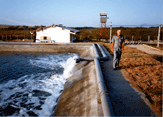
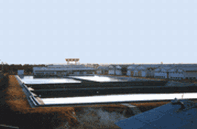
YOKOTA Seawater Intake Pumps have actually been supplied to various facilities
such as experimental fishery stations, fish hatcheries, and fish farms,
however, the following is an example of an application at a large-scale
shrimp hatchery.
Good water maintenance is the foundation of the fishing industry, and for
fish farms this literally means a stable, economic supply of seawater is
what is most important. Because shrimp require especially pure seawater,
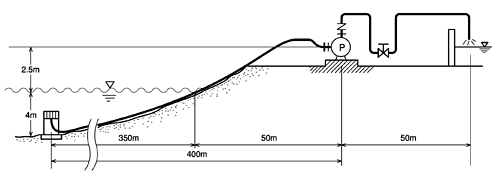
it is delivered to the hatchery from a distance of 350m offshore.
At such a distance, and in consideration of possible damage caused by weather
conditions such as typhoons, the safeness and manageability of submerging
a pump in the sea (submerged/vertical pumps) is unsuitable.
As a result, land-based pumps have been preferable, with the installation
location set across a flat surface 50m from the shoreline and at a height
of 2.5m above the sea surface. However, this type of installation requires
extensive piping of over 400m.
Nonetheless, stable and assured pumping is indispensable, because as far
as the shrimp hatchery is concerned, pumping problems would only result
in product loss.
In answer to these concerns, we have thoroughly developed a continuous
air-bleeding system and created a package with even greater self-priming
power in our YOKOTA Self-Priming Centrifugal Pump UHN type interlocked
with the YOKOTA Vacuum Pump VP-K type. Added to this package is an assembly
including the YOKOTA Non-Water Hammer Check Valve for absolute protection
against water hammer and, together with the No-Feed Detector and control
panel, this system provides complete automated operation.
|
|
|

|
|
|
|
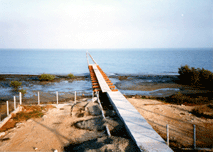
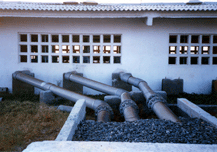
Absorbing water from the sea
|
 |
|
Suction piping
|
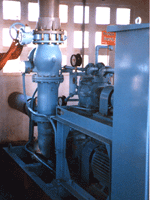
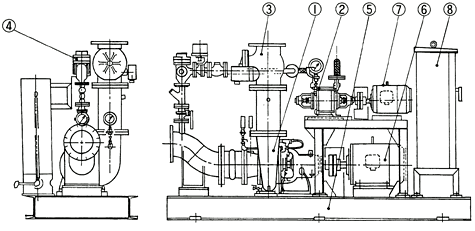
YOKOTA Automatic Seawater Pumping System, a pump package with complete
functionality
|
|
Main pump:
|
UHN type 200mm x 3.6m3/min x 18.5m x 1750min-1 x 18.5kW
|
|
Vacuum pump:
|
VP-K type 5.5kW
|
|
|
|
|
1:
|
Main pump
|
|
2:
|
Vacuum pump
|
|
3:
|
Non-Water Hammer Check Valve
and No-Feed Detector
|
|
4:
|
Priming detector
|
|
5:
|
Common base plate
|
|
6:
|
Main pump motor
|
|
7:
|
Vacuum pump motor
|
|
8:
|
Control panel
|
|
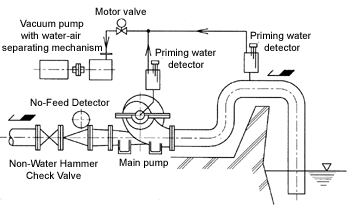
This system's operation order is as follows:
|
1.
|
When the switch is turned on, the vacuum pump is activated.
|
|
2.
|
When the priming detector detects that the suction piping is at full capacity,
the main pump is activated and pumping begins. To conserve energy, the
vacuum pump is stopped.
|
|
3.
|
Even if air is sucked into the system or air dissolved in seawater becomes
extricated during pumping operation, the self-priming mechanism in the
main pump itself processes these types of air intake without any problem
for stable, continuous pumping.
|
|
4.
|
In the unlikely event a large amount of air is sucked into the system causing
pumping problems, the amount of water passing through the Non-Water Hammer
Check Valve approaches zero, whereby the built-in No-Feed Detector detects
this condition, activates the vacuum pump and automatically returns operation
to number 1. above.
|
|
5.
|
If the water intake surface changes severely and a large amount of air
intake is anticipated, the vacuum pump can be switched to continuous operation
for stable and continuous pumping operation.
|
The UHN type pump itself, which is used here as the main pump, provides
high performance self-priming.
Yokota Self-Priming Centrifugal Pump UHN type (PAT.) features
|
|
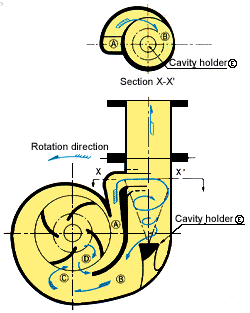
Casing consists of a simple construction with a semi-double volute and
a cavity holder. A single-suction, single-stage pump displaying outstanding
pumping efficiency in a wide assortment of specifications.
|
|
|
Outstanding self-priming power, with a maximum vacuum reaching 60-90kPa
(6-9m water column).
|
|
|
Low NPSH. Even if cavitation develops due to fluctuation in intake conditions,
this pump can still continue pumping operation and does not require allowance
for NPSH.
|
|
|
Even if pumping becomes subject to air suction or mixture of air during
pumping operation, it continues pumping without a problem. Even continuous
suction of air-containing water (i.e., gas-liquid two-phase pumping) is
possible.
|
|
Self-Priming Centrifugal Pump UHN series
|
|
|
Self-priming mechanism
|
|
|
|
|
Example application 2 - "Chemical plant" |
|
|
|
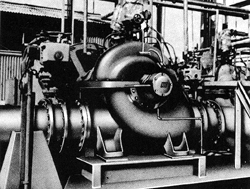
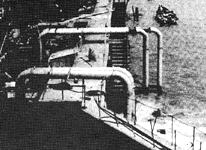
This example concerns a pump application at a large chemical plant.
Because a large amount of seawater is needed for cooling, the main pump
that the plant uses is a large capacity YOKOTA Double Suction Volute Pump.
Having adopted the continuous air-bleeding method, the convenience of a
piping arrangement over higher elevations is possible without fear of air
suction during pumping operation.
|
 |
|
Main pump:
|
HD type 50m3/min x 25m x 900min-1 x 300kW
|
|
Vacuum pump:
|
VP-K type 2.2kW
|
|
|
Example application 3 - "Thermal power plant" |
|
|
|
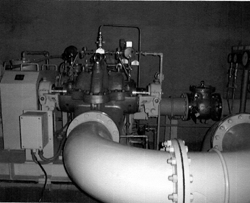
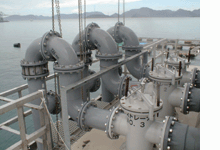
We have numerous pump applications for thermal power plants, however, the
example we are discussing here concerns the "screen cleaning pump"
that cleans the screen at the seawater intake of a thermal power plant.
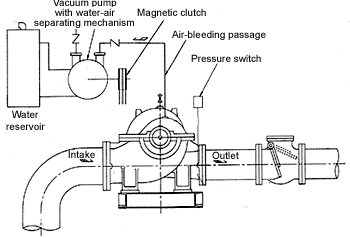
The main pump used here is the medium capacity YOKOTA Double Suction Volute
Pump. Having adopted the continuous air-bleeding method, it is a completely
automatic, high-efficiency self-priming pump.
Moreover, with the aim of reducing inspection frequency by protecting the
equipment from water hammer, the YOKOTA Non-Water Hammer Check Valve has
been adopted for absolute protection against water hammer.
The main pump and Non-Water Hammer Check Valve have also been produced
with the particular aim of reducing inspection frequency by protecting
the equipment from seawater corrosion (such as crevice corrosion) using
YOKOTA Seawater Resistant Stainless Steel YST130N.
|
|
|
Main pump:
|
HD type 7m3/min x 75m x 1800min-1 x 120kW
|
|
Vacuum pump:
|
VP-K type 3.0kW
|
|
|
Water hammer protection using the Non-Water Hammer Check Valve
|
|
|
Corrosion protection using Seawater Resistant Stainless Steel YST130N
|
 |
|
Regarding the YOKOTA Non-Water Hammer Check Valve (PAT.)
|
|
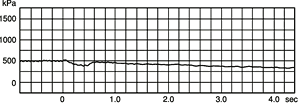
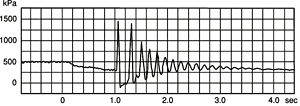
The valve opens and closes in response to water flow, therefore there is
no delay in valve closure and water hammer does not occur.
|
|
|
The single-disk, simple construction eliminates breakdowns. Maintenance
costs can be reduced considerably.
|
|
|
The No-Feed Detector can also be installed optionally.
|
|
Pressure change over time after pump operation is stopped
|
|
YOKOTA Non-Water Hammer Check Valve
|
Conventional check valve
|
|
|
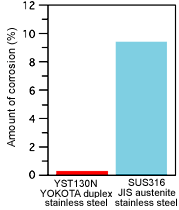
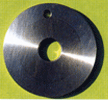
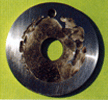
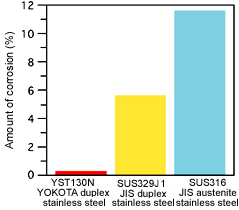
Regarding YOKOTA Seawater Resistant Stainless Steel YST130N
YST130N is a duplex stainless steel alloy independently developed by YOKOTA
with excellent corrosion resistance to seawater and chemicals.
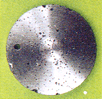
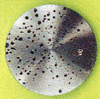
Results of actual field tests clearly show that YST130N has excellent crevice
and pitting corrosion resistance.
|
|
|
Pitting corrosion resistance
|
|
Loss due to pitting corrosion
|
5% ferric chloride 40 deg C, 50 hours
|
|
|
Test piece after field test
|
|
YST130N
|
SUS329J1
|
SUS316
|
|

|
|
|
|
|
For details of each product that makes up the Seawater Intake Pump System,
please refer to
Self-Priming Centrifugal Pump UHN series
Process Pump UB series
Double Suction Volute Pump HD type
Mixed-Flow Volute Pump YM type
Non-Water Hammer Check Valve SL series
Seawater Resistant Stainless Steel YST130N
|